Wednesday, January 27, 2016

All We Are Saying Is: Give 'War and Peace' a Chance

Здравствуйте! It is I, Arsenic Pie, your favorite Slavophile and BBC nerd, here to apprise you of the BBC production of War and Peace that everyone is ranting about. 


Война и мир

Need something to watch while you work on your Russian tricolor blanket knitting project? Have no fear. The BBC's adaptation of War and Peace has all the people sobbing in corsets and bodice ripping you need. Given the current posturing by various presidential candidates who shall remain nameless, BBC's adaptation comes just in time to remind us all that pissing off Russia is a really fucking bad idea. 


This is Napoleon Bonaparte. Napoleon invaded Russia. Napoleon got his ass kicked. Don't be like Napoleon.

I've seen every BBC costume drama on the planet, so trust me when I say that their War and Peace is a competent production, albeit very, very typical output from the BBC. However, the incest in this is new. Usually the BBC = not much incest. Not a whole lotta brother/sister groping going on in Jane Austen, know what I'm sayin'?

No, it doesn't reach the storied glories of Soviet director Sergei Bondarchuk's 1967 adaptation. However, if you want to watch people sporting posh British accents pretending they are speaking Russian, it's not a bad way to spend an afternoon. Part 1 is very slow. This is where the script could have used a little bit more ooph. Paul Dano's performance as Pierre Bezukhov, however, carries the weight of the production, and keeps up the interest into Part 2. Part 2 picks up a bit more steam, with Part 3 really getting into the meat of the story. We all know Bezukov is Tolstoy's Mary Sue, so perhaps it isn't surprising that he comes through as the most interesting character in the series. As for Dano, give the man a Golden Globe already. As far as BBC adaptations go, I personally preferred their recent adaptation of Poldark, but I am planning to watch War and Peace like it's my job. And I will knit. I WILL KNIT FOR MOTHER RUSSIA. 

BBC Wales certainly brought out their heavy hitters. British go-to novel adaptation screenwriter Andrew Davies has created a pretty faithful script.  The production values are no less what one would expect from one of BBC’s famous big-budget costume dramas. The cast list reads like a Who’s Who of respected or trendy British (and a few American) actors: Paul Dano of Little Miss Sunshine stars at the bespectacled and well-meaning Pierre Bezukhov; Lily James of Downton Abbey is Natasha Rostova; James Norton (Grantchester) is Andrei Bolkonsky; Jim Broadbent (Iris, Vanity Fair) is Prince Nikokai Bolkonsky; Aisling Loftus (Mr. Selfridge) is Sonya Rostova; Gillian Anderson (FUCKING DANA SCULLY) is Anna Pavlovna Scherer; and Greta Scacci (Emma, Daniel Deronda) is Countess Natalia Rostova. 

Aside from the enormous budget and glittering cast, the movie itself is a respectful treatment of Tolstoy’s epic. Russian culture -- from traditional chant overlaid on the battle scenes to Orthodox weddings and baptism -- is treated as a natural part of the film’s backdrop and storyline, so not a whole lot of Otherizing going on. Although, somebody on the production team told the "Austrians" to sport poorly executed accents. That was a bad call. They sound like Nazis.

War & Peace was shot on location in Latvia, Lithuania, and Russia in such locations as Catherine Palace, The State Hermitage Museum, The Russian Museum, the Yusopov Palace, and was funded in part by the Lithuanian Tax Incentive for Film Production, and features the musical talents of the State Choir of Latvia.

If you are looking for something in a similar vein, I recommend heading over to YouTube and checking out Rossiya 1’s Ekaterina (with English subtitles), a 12-part miniseries which depicts Catherine II’s early years in Russia. It definitely gives Beeb productions a run for its money, and as Rossiya 1 = BBC, the diction and intonation of the actors is quite clear and easy for Russian language learners to understand.

War & Peace is airing stateside on the History Channel, A&E, and Lifetime (really). It’s also available via streaming on Amazon video.

Saturday, January 23, 2016

Mercy Me

Greetings, fellow TV Sluts! If you're on the East Coast chances are you're stuck inside for the foreseeable future thanks to Snowzilla 2016. Why not read a chat Arsenic Pie and I had this past week about the new PBS series, Mercy Street? 

"Based on real events, Mercy Street goes beyond the front lines of the Civil War and into the chaotic world of the Mansion House Hospital in Union-occupied Alexandria, Virginia." As you'll see below...I wouldn't say we loved it. --Maggie Cats


Arsenic Pie (AP):  GANGRENE BITCHES. THAT WOUND IS OOZING AND SMELLS FOUL ALSO WOULD YOU LIKE TO HEAR MORE ABOUT HOW SLAVERY IS WRONG

Maggie Cats: (MC): I hope you aren't referring to the show in general with the "gangrene" and "oozing" comments.

AP: Not in a general sense, no. But as I stated before I was disappointed that there was no Neil Patrick Harris nor syphilis. Here's hoping.

MC: Maybe they will do a crossover with the now-cancelled Best Time Ever. Like, he can pop in to the room during amputations for a song and dance number.

AP: And use amputated limbs as props. See, we could write this. If they did that the show probably wouldn't have gotten cancelled.

MC: So what did you think of Mercy Street really?

AP: Well, from a production values standpoint it's on par with Downton Abbey and the BBC.

MC: But....

AP: But I felt in their attempt to be "fair," they are kind of whitewashing history and (don't hit me) making the Union look like the bad guys. Like, the Chief of Staff at the hospital is a dickbag. Nobody wanted to treat the Confederate soldier. The Union officers in charge of the hospital wanted to cheat the nice Confederate family. A little balance is needed, otherwise is comes across as propaganda. And if I need that, I'll just go watch Gone with the Wind for the twentieth time.

MC: I understand what they are trying to do, to show the nuances of all the different things people were thinking at that time, but it felt like there was way too many grand pronouncements of morality and war and politics shoehorned into the narrative. I actually thought the Green family didn't come off looking so rosy; I mean clearly they are rich people with their heads stuck in the sand. LA LA LA I CAN'T HEAR THE SOUND OF THE UNION KICKING OUR ASS. But yes, they were clearly trying to demonstrate that "Confederates are people toooo!" Which ok, they were, but also, HELLO, SLAVERY. Of all the characters we met, I actually found the freeman surgeon the most compelling.

AP: Yes, and with Mary Phinney, the only abolitionist we've met so far being an insufferable shrew, and with the Union doctor being a horrible racist, I am really not sure what thesis they're trying to put forward. The Green family has the most likable characters. Emma is a lot more likable than Mary.

MC: I am hoping that as we go on, all the characters will become a bit more fleshed out than walking signboards for "I represent this side of the argument."

AP: Yes, too many grand pronouncements. Who meets Dorothea Dix and is like "Let me hold forth on my views about race and equality."

MC: If it was set anywhere other than Alexandria, I probably wouldn't keep watching. The characters are one-dimensional at this juncture. But it's my hometown, yo.

AP: Shout out to the Army of Northern Virginia.

MC: Ummm....woot? I AM UNCOMFORTABLE BY THIS.

AP: I also disliked that the only African American Mary had any contact with was like, "It's all good. I'm free. If only these racist as Northerners would let me practice medicine." Like be fair all you like, but if they're going to whitewash slavery, I'm going to call them out. I NEED A RACIST-ASS.

MC: I am sure someone will get horribly beaten soon. Don't fret.

AP: Okay. Good. I don't want my moral high horse to have been for naught. Hopefully Josh Radnor. Which is almost too bad because he looks good with the beard.

MC: And is less insufferable than Ted.

Trust me, you don't want this guy shooting you up with anything.

AP: I never watched How I Met Your Mother I was in it for the NPH for a hot minute and I got bored and tuned out.

MC: I think I watched a couple seasons in the beginning. But I wouldn't call myself a fan. As insufferable as Ted was, this guy, the doctor, who liberally shoots people up with morphine, is way better. I can't wait for the inevitable love triangle with Mary and the hot priest to kick in. Wait, I'm sorry. The hot chaplain. Or whatever.

*interlude where Arsenic Pie goes and gets her Red Baron oven pizza*

AP: The people I like the most are the Greens.They are sympathetic,and they are a nice family. And the dad is the dad from Talladega Nights. I don't like Baroness Munchausen, and the doctor is more likable than she is, and I did enjoy him telling her off.

MC: I also liked the Dad and the eldest daughter. Everyone else, including the Mother, despite being in Center Stage and a Star Trek movie, are kind of awful and insipid. Mary also looks so much like the actress who was in Scott Pilgrim it's distracting.

AP: She does. And what is Anna Sophia Robb doing on this show? Doesn't she have better things to do than lay around in a crinoline and swoon.

MC: I take it back, the hot chaplain he is my favorite character.

AP: Yes, and what a highly developed character he is,what with his two lines of dialogue.

MC: He doesn't need to speak. I can see it all through his soulful eyes.

AP: I'm telling your boyfriend.

MC: OH HE KNOWS. So, are you going to stick with Mercy Street?

AP: I might. I'll give it a go. I hated Mr. Selfridge at first, and then I ended up getting past all of the melodrama and enjoying it. But Mercy Street is kind of cliched. T

MC: The dialogue and the setting and the characters really don't stand out from anything else I've seen set during the Civil War. I'll give them a few more episodes. If nothing else for the dress porn.

MC: Keep those hoop skirts coming, ladies! So practical for nursing.

AP: It was kind of underwhelming but I honestly didn't expect that much. Hopefully, a few more episodes in and it should find its legs. Maybe Mary will kill someone with her vagina. Stranger things have happened on PBS.

MC: I am sure Lincoln will show up at some point.

AP: Those hoop skirts and corsets definitely allow for a nurse's freedom of movement.They should definitely give their costumes to Call the Midwife. I think Lincoln is due in the next episode. It's still supposed to be 1862 so we don't have to worry about him getting shot.

MC: Well, that's a relief. I am sure there will be a parade of distinguished figures through the hospital.

AP: Although, IMDB has a character listing for John Wilkes Booth.

MC: I was JUST wondering about that!

AP: I hope not, because I think that is such a cop-out to do stunt casting.

MC: And of course they'll have JWB. He was a well-known actor. Where else would he go but an Alexandria hospital.

AB: I wonder if we'll get to see him being a terrible fucking actor.

MC: This is what happens when artists get frustrated, people. They shoot presidents and commit genocide. Good thing I am a boring lawyer.

AP: I expect zero atrocities from you.

MC: When I get frustrated I just make a rubber band ball.

AP: Would you like to have some atrocities attributed to you?

MC: Let me make a Pro and Con list and get back to you.

AP: I've literally broken stress balls. No joke. I've broken like five of them.

MC: You have super strength. You are the hulk.

AP: RAAWWWWRR No stress balls are safe.

MC: No balls at all, actually.

AP: That's good news for the chaplain! We'll leave the ball-busting to Mary Phinney.

MC: That guy doesn't have any balls anyway. NAILED IT

AP: I don't know why we don't have a show.

MC: It would be a hot mess and fantastic.

AP: I concur. We'd have a zillion followers due to our wit and timely zingers.

MC: And my spectacular rack. Don't forget that, it's my power source.

AP: Your rack is far superior to my own.

MC: I should sooner pick a favorite star.

AP: You have an excellent rack. Mine are merely perky.

MC: See, we have something for everybody.

AP: And that's really all I ask. Stay perky, my friends.

MC: Once again, we have gotten completely off topic. But honestly, this is more compelling than the show.

AP: It really is.

MC: We'll be here all week. Try the veal!

AP: It's delicious Don't believe me, ASK THE DISHES.

MC: I think that's a good stopping point. We covered the basics.

AP: It's always good to know when you should throw in a good "Be Our Guest" reference.

MC: It really brought the whole thing home.

AP: It really tied the room together.

Time to go, I'm off for another day of nursing dressed all in white with my corset and 20 layers of underwear! I just need to navigate all the street cat-callers first....

Mercy Street airs Sundays at 10PM on PBS. Check your local listings for channel information.

Tuesday, January 19, 2016

Doctor Who Season 9: Love It or Leave It

It’s been a while since your TV Sluts have talked much about The Doctor. Having finally finished the latest season of the very long running show, I naturally have thoughts about it. The most recurrent thoughts being, “WTF?”

Season 9 is an odd one. For the most part, it felt to me like slog just to get through. I was, in fact, ready to write off the entire season until the last three episodes came out of nowhere and got unexpectedly amazing. At its worst, the season was trying to be too clever for its own good. At its best, season 9 delivered some cool twists, sent some characters flying, and delivered what is legitimately one of the best episodes of Doctor Who ever made.

Given the dual nature of the season, I’m here to help you figure out which episodes you need to watch and which ones you delete off your DVR queue.  Generally, everything I say will be spoiler-free up until the final three episodes, which are as spoiler-y as can be. As a note, I’m including the most recent Christmas episode, even though it’s technically a part of season 10 because the BBC is just weird. Onward!

Wibbley wobbly coat-y woat-y
Episodes 1 & 2: The Magician’s Apprentice/The Witch’s Familiar
Summary: The Doctor discovers that he is inadvertently responsible for making one of his own arch-enemies, Davros, the creator of the Daleks. For two episodes, The Doctor and Davros speechify at each other about their respective lives and deeds. In an almost unrelated story, Clara teams up with Missy to get the Doctor and… do something. It’s never totally clear.
Should you watch it? Only the scenes with Missy and Clara. Missy is one of the better new creations to the Doctor Who universe and the action between the two of them is fast-paced, funny, and exciting. The Doctor’s scenes drown themselves entirely in the show’s own mythology and need to be clever.

Episodes 3 & 4: Under the Lake/Before the Flood
Summary: The Doctor and Clara come to an underwater base and discover an alien space ship and a whole bunch of dead people who keep coming back as ghosts. The episode gets incredibly timey-wimey as The Doctor must go back in his own timeline to just before the two of them arrive in order to save the day.
Should you watch it? In a word, no. At best, this should have been a single episode. Stretching it into two is painful. Hardcore fans, who will watch anyway, will appreciate a few Easter Eggs dropped into the dialogue, but for the rest of it it’s just a waste.


Arya Stark is really progressing this season.

 Episodes 5 & 6: The Girl Who Died/The Woman Who Lived
Summary: The Doctor and Clara attempt to save a pre-historic Viking village from aliens masquerading as gods. In doing so, they rely on a precocious girl in the village named Ashildr, played by Maisie Williams (Arya Stark from Game of Thrones). In the process, Ashildr is granted immortality. In the second half, The Doctor discovers Ashildr thousands of years later in 1600s London, now completely changed by her immortality and not necessarily for the better.
Should you watch it? Oh my, yes. The first episode is really just a set up for the second, but for completeness of story and for recognizing how awesome Masie Williams is in this part, it’s well worth it. “The Woman Who Lived” was the first episode this season that I actually loved. It felt like the best kind of Doctor Who episodes of the past.

Episodes 7 & 8: The Zygon Invasion/The Zygon Inversion
Summary: Remember the Zygons from the 50th Anniversary episode and their “pretend to be human and infiltrate Earth” plan? They’re back and up to their old mischief. The entire episode is largely an excuse to bring back the character Osgood, who died in last season’s finale. It also tries to make a statement about human nature, though largely falls flat.
Should you watch it? No. While the episodes bring back some fan favorite characters, that’s not enough to give up two hours of your time.

Episode 9: Sleep No More
Summary: The lone standalone episode of the season, The Doctor and Clara find themselves on a space station with a mysterious enemy slowly hunting down and killing the crew. The show usually tries to do a space-themed horror episode once person season; this is it.
Should you watch it? Skip this one. The horror never really materializes and it mostly feels like a filler episode. Though at least it’s only a one-parter.

As I said at the top, the last three episodes of the season are all 100% worth watching. They are, in fact, wonderful and are the ones that reminded me that Doctor Who isn’t out of ideas and fanciful storytelling just yet. Watch all of these!

WARNING: SPOILERS IN THE NEXT THREE EPISODES!


Scarfs are cool.
Episode 10: Face The Raven
Summary: Clara attempts to save a friend who has been sentenced to death for a supernatural murder that he doesn’t remember committing. In the process, she and The Doctor are reunited with modern-day Ashildr (Maisie Williams again) who has calmed since her last meeting with The Doctor in the 1600s and is now a protector of people who have been affected by him. To that end, Ashildr has set up the entire bogus murder in an attempt to trap The Doctor in an effort to keep him from harming anyone else. Clara’s self-confidence and attempts to out-clever everyone backfire and she is killed in front of The Doctor as he is teleported somewhere else…

Oof. This episode. I can't you guys... All the feels...
Episode 11: Heaven Sent
Summary: The Doctor arrives in his prison, a large castle somewhere unknown completely surrounded by an ocean of water and haunted by the memory of not being able to save Clara. The only other thing in the castle is a silent, shrouded figure that constantly pursues The Doctor, attempting to kill him.  Finally deducing a way out, The Doctor is caught by the figure, who kills him at the very same time he re-appears exactly where he began. The Doctor eventually deduces that he is caught in a cycle whereby he searches for an exit and is killed that has been going on for over 7,000 years and the only way to break free is to continually try to beat it, a process that lasts for over 4 billion more years. In the end, the Doctor is freed and finds himself standing on Gallifrey.

Episode 12: Hell Bent
Summary: The Doctor declares war on Gallifrey’s High Council and extracts Clara from her own time-stream moments before her own death in an attempt to save her. When this doesn’t work, The Doctor takes the TARDIS to the very end of the universe to see the only other person who will be there: Ashildr, who tells him that he and Clara cannot be together because they are too catastrophic. The Doctor attempts to erase Clara’s memories of him but the process backfires and he instead forgets most of his memories of her. At peace with her death but assured that it will happen, Clara and Ashildr use a TARDIS of their own to return Clara to the moment of her death, but not before deciding that they could perhaps “go the long way around” and vanish off into space and time.

SPOILERS ARE DONE! BACK TO REGULAR PROGRAMMING!

Goodbye, Sweetie?
Christmas Episode: The Husbands of River Song
Summary: Your favorite (or not) Moffat-era character returns as The Doctor encounters River Song near the end of her life, just prior to going to The Library. River is unaware of the 12th Doctor and thus doesn’t recognize him but uses him to help her pawn a very valuable diamond that she’s married a dictator for with the plan of swindling him out of it. A madcap adventure ensues, ending with The Doctor and River’s final night together before she is destined to go to her death in “Silence in the Library”.
Should you watch it? Your mileage may vary, depending on how much you like River. As a fan of her character, it gave me all the closure I have wanted for her story. If you prefer to think of The Doctor without his wife (it happened; deal with it), you can likely skip it.


So where does that leave us? Far too many of the episodes fell victim to Doctor Who writing at its worst, which is to say needless complexity and cleverness for the sake of being clever without any of the actual sense of adventure or wonder. Showrunner Steven Moffat in particular suffers from this from time to time, though he’s not the only one. This cleverness for cleverness’s sake is evident in the mandate that rather than have a season-long story arc, every two episodes would be paired together for two-part story with a neatly hook-y title denoting how they relate to each other. And while I appreciate that approach as one that doesn’t make me wait for a big payoff that inevitably won’t be as earth-shattering as it is promised, it also means that a story that doesn’t grab you is doubly-long and hard to sit through. Unfortunately, that was the case for a lot of the stories here.

What serves as a trip-up for this season likely comes down to the basics. I like the 12th Doctor. I like Clara Oswald. I like Peter Capaldi. I like Jenna Coleman. I like all these things. What I apparently don’t like is what happens when they all come together. Clara and The Doctor have never totally clicked, despite strong performances from two (actually three) likeable actors. This is incredibly disappointing for me given how incredibly strong Clara’s introduction was, way back in Season 7’s “The Asylum of the Daleks”. I could write an entire post about Clara and what made her work relative to what made her different, but for now I’ll just say that she became problematic, though her character was delivered some kind of justice by giving her an ending that is absolutely worthy of what her character should have been all along.

Emo sigh.
All that said, I absolutely loved the poetry and genuine emotion and fun that last three episodes and the Christmas episode manage. “Heaven Bent” in particular is notable for storytelling that hits every note it needs to and does so while packing an emotional wallop. It’s worth noting that entire episode only contains two speaking parts, The Doctor and one other character who gets one or two lines at the very end. Likewise, “Hell Bent” gives us a peek at an alternate reality Doctor Who with Ashildr and Clara going off in their own TARDIS that is stuck looking like a 1950s American diner and that’s a TV show I would watch the hell out of. The excitement evident in those final episodes save the season from being a complete misfire.


So, get to watching the good stuff. Ignore the boring bits. And join the rest of us in waiting to see just who exactly will be the next companion now that Clara has exited the show. I’m still waiting on them to bring back Donna, though. 

Or, you know, two chicks with their own TARDIS would be cool too...

Thursday, January 07, 2016

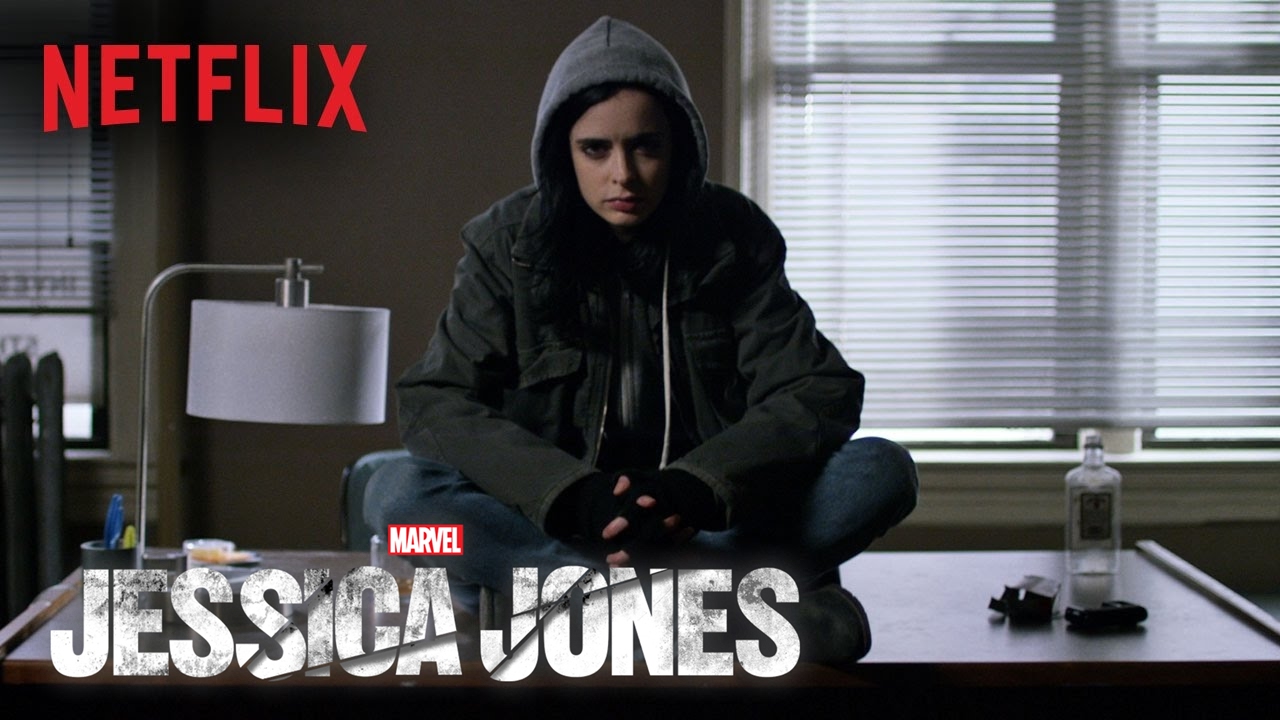
Jessica Jones Never Says "I Love You"

So, I had three shows that I binged over the holidays with a mind to write posts about all three of them. Those three were The Man in the High Castle, Making a Murderer, and Jessica Jones. All of which your TV Sluts have just covered. Sigh. I present, with apologies, my take on Jessica Jones anyway with the promise to get on my game for my next post and make it on something that we haven't already run our collective mouths about.

Cards on the table: While I’ve largely liked and enjoyed (nearly) all of Marvel’s combined movies (that would be the Iron Man/Captain America/Avengers oeuvre that regularly dominates the world’s box offices), I’ve never loved any of them. They’re too slick, too formulaic, too safe. They’re solid entertainment, surely, but there’s never any thought that they’re anything other than animated picture books with no real stakes or consequences for any of the characters. Marvel’s TV shows have done a better job at building actual characters, but I’ve still been hard-pressed to watch any of them and really commit.

All that said, I frickin’ love Jessica Jones. I’m not sure how they pulled it off, but the show’s creators came up with a series that fleshes out the Marvel Cinematic Universe in a believable and interesting way while subverting that universe at the same time. And it’s incredible to watch.

Break out your Veronica Mars references. They're all accurate.

Before I say more, here’s the requisite backstory you need if you’re not steeped in these characters: Jessica (Krysten Ritter) is a sorta superhero who tried to make a go of being heroic at one time and it just never really worked out for her. She now uses her smarts, considerable strength, and not-at-all mastered ability of flight (she calls it “more like controlled falling”) as a private eye, albeit one who has yet to make too much of an impact. As such, she is outside the superhero game. She has no costume, no fancy globe-trotting adventure fighting large Evil Empires. What she does have is an enemy in the form of Kilgrave (David Tennant) who can compel anyone listening to his voice to do whatever he tells them to do. Jessica herself is a former victim of Kilgrave’s, having been compelled to be his companion before breaking free.

And right there you have the seeds of what makes Jessica Jones so interesting to watch. This is a show about a hero who has PTSD and has turned into her own best self-destruction machine trying to deal with it, hiding her damage in violence, cynicism, detachment, and literally gallons of hard alcohol. And while both the noir and superhero genres have their fair share of heroes with a dark past, Jessica Jones elevates both by calling out the horrors of her past more than is typically done. She’s a rape survivor, the only member of her family to make it out of a fatal accident, and a manipulator who veers closely to doing to others what was done to her.

Actual excerpt from the comic detailing Jessica and Kilgrave's interactions. Archie, it ain't.

Jessica as a character fits nicely into the anti-hero trope, but the show consistently moves her beyond a caricature and into someone who feels real. Her rape is a great example; writers often make the mistake of using a female character’s rape as a way of depowering her to exploit her vulnerability. In a lot of writer’s minds, rape = Strong Female Character. Jessica Jones avoids this by exploring how affected Jessica as a person is by her captivity, particularly given that it was a captivity that invaded her mind first and foremost. Her physical and mental rape isn’t something that motivates her; if anything she’s running from it. Which is to say, she’s behaving like a real human person and not a convenient backstory generator.

A show anchored by a fully-fleshed out female character is, by itself, almost unseen even in our supposedly enlightened times. Now consider that the other lead characters in this show are a black man (Luke Cage, a perfectly cast Mike Colter), a second white woman (Trish Walker played by Rachel Taylor), a lesbian woman (Carrie-Anne Moss), and another black man (Eka Darville) with a primary assist from a Latina woman (Rosario Dawson, reprising her Daredevil role) and you’ve got a cast not normally assembled. Only one main character is a white man with one other white man in a supporting role. For the Marvel Cinematic Universe, which has too often veered into looking like it was filmed in the same New York that was occupied by the cast of Friends, this is remarkable. And like Jessica, the other characters more often than not defy the traditional ways that they are represented, allowing them to have their own stories.

Consider this: the show has a woman and a black man, two populations that are traditionally expected to be docile and unobtrusive in “polite” society, to actually get violently angry. Jessica doesn’t just fight to protect herself; sometimes she does it simply because she’s pissed and needs to hit someone. Her on-again, off-again love interest Luke’s anger is portrayed more righteously, but just the image of a large, intimidating black man being mad is itself subversive given that it’s shown to a presumably majority white audience. (It’s worth noting that this same construction was illustrated even more explicitly this fall in DC’s Supergirl in what was probably one of the best scenes that show has put out yet.)

That sound you're hearing is Donald Trump supporters freaking out over this.

The feminist interpretations of this show are clearly everywhere. The motif of Kilgrave’s commands to Jessica that she smile more will on their own launch a thousand women’s studies theses. What really made me fall for the show though had to do with how they integrated this punky little story into the larger MCU narrative. I said earlier that the show both made the Marvel universe bigger while subtly smacking it across the face at the same time. It accomplished this by allowing consequences to actions that actually raise the stakes of the story and establish tension. Unlike the big movies, you can watch Jessica Jones and not be sure what’s going to happen to the characters. Survival isn’t an assured outcome and even if a character lives, he or she may not be able to overcome what has happened. Jessica and her compatriots are underdogs in the truest sense. They’re the characters literally crushed by their big screen counterpart’s actions, as several characters make clear when they outline the people they lost in the Avengers’ destruct-a-thon battle for New York in their movie. The show is an antidote to the high-contrast, fluffy spectacle of the movies.  If the Marvel movies feel like they’re written by comic book writers, Jessica Jones feels like it’s written by the staff of Orphan Black. Not to put too fine a point on it, it’s also worth mentioning that this is the first, yes first, of all of Marvel’s productions to feature a female lead character. Scarlet Johannsen’s Black Widow hasn’t even managed to get her own movie yet.

"We're both multi-faceted adults with independent stories. So, should we talk about a man right now or...?"

To be sure, Jessica Jones has its flaws. The story takes off like a rocket and finishes like an explosion, but unfortunately there’s a little sputtering in the middle when the show seems to circle itself needlessly. A few storylines never quite take off; Kilgrave wants photos of Jessica enough that he manipulates the people around her to provide him with them covertly but once he’s found out the reason for this is never really allowed to breathe. Likewise, some of Jessica’s neighbors seem tossed in more to provide things for the show to do rather than actually serve the narrative. In general, the pacing of the show can become uneven at times. For what the show manages to pull off, however, it’s kind of brilliant.


So far, Marvel/Netflix have been mum on whether or not they’ll green light a second season for the show. Netflix is notorious for keeping its ratings close to its chest, so it’s hard to get a sense of how well the show performed in the traditional sense, although critical response has been largely very positive and the fan response was equally upbeat. What it will likely come down to is the extent to which Marvel is willing to deviate from its established schedule of shows with Luke Cage, Iron Fist, The Defenders, and Daredevil’s second season already in the pipeline. And while Jessica has been intended to play a role in the upcoming The Defenders series, it’s still unclear of the next time we’ll see her or get more from her story. 

Wednesday, January 06, 2016

Making a Murderer

This post contains discussion of the basic plot of Making a Murderer. I don't reveal the outcome of the series or linger on too many details, but to err on the side of caution I would characterize it as containing mild spoilers. 

Unless you've been living under a rock, you've heard of Netflix's original documentary series, Making a Murderer. Shot over a period of 10 years, the 10 episode series relates the tale of Steven Avery--a man wrongly imprisoned for 18 years for sexual assault, exonerated by DNA evidence, and rearrested for murder only two years later.

There's no doubt the True Crime genre is hot right now--last year Serial and The Jinx had us all on the edge of our seats. And Americans have always been enthralled with true tales of violence and death. Just look at the popularity of series like America's Most Wanted, Unsolved Mysteries, and the immortality of killers like Jack the Ripper. I don't know what it is about crime, procedurals, and serial killers that fascinates us so. Maybe it's about turning a mirror on the worst part of humanity that titillates us...and makes us feel better about our own ordinary lives.

Making a Murderer does not provide this kind of escape. The mirror isn't turned on the dark heart of one person, rather the mirror shows the unfortunate reality of our own justice system. There is a myth of American justice, of the presumption of innocence, but if you take one thing away from Making a Murderer it should be this: the system is broken.

I went into Making a Murderer not really knowing what to expect. I had read some reviews so I knew the plot basics (though it feels weird to call people's real life tragedies "plot"), but nothing can really prepare you for the way things unfold in the series. Disbelief, shock, anger, rage, disbelief (again), sadness...these are all feelings I experienced. I also talked to the television a lot while watching. Things like, "I can't believe this," and a lot of profanity were thrown around my apartment.

This is pretty much what I was thinking every time one of the Sheriff deputies was on screen.

In case you didn't know this about me, I'm a lawyer. I took criminal law classes, I participated in trial competitions, and I worked with my state's prosecutors during law school. So I wouldn't call myself naive or uninformed about how our system works. But I was still completely gobsmacked. Maybe because I am a lawyer and an officer of the court, I believe in the fundamental rightness of the system. I believe that most of the time we get it right and the cops and courts WANT to get it right. So the idea of a conspiracy to convict the wrong guy just seems so unlikely as to be fundamentally inconceivable.

At least...I used to believe this. Now I only feel sad. Because I think I was wrong.

I have read tons of articles about the racism and classism inherent in our system. I've shared some on Facebook. I know how the deck is stacked against those who are poor or not white or looked down on as the dregs of society. I know that the death penalty is not applied fairly and I know that the drug laws aren't either. But to see how everyone and everything in the system works against Steven Avery and his nephew at every step of the process, even one of their own defense lawyers, puts everything into cold, stark, reality. I now feel sad and cynical.


I've spent a lot of time and words so far talking about how the show made me feel and how it has altered my personal perception. But is Making a Murderer actually any good? Should you watch it? Yes. In fact, hell yes. This is a show that I now feel obligated to recommend to you. Not just because it's a masterful work of documentary film making (it is) and not just because it is utterly compelling (it is that too), but because it feels almost like it should be required viewing if you want to call yourself knowledgeable about the country you live in. Sure, Steven Avery is just one man. But if you think this couldn't happen anywhere in America, then you are deluding yourself.

The question a lot of people ask upon finishing the series is, "so did he do it?" My answer is "I don't know." But that's not even really the point. I don't want to say it doesn't matter whether he did it, because that is a gross insult to the victim, Teresa Halbach, and her family. Teresa Halbach died. Whether Steven Avery is the one who killed her or not, there is no doubt that she died horribly, that her family went through hell, and that they deserve to know who perpetrated this crime and have some measure of justice (or maybe revenge?). But the fact is, this documentary centers on Steven Avery, not Teresa Halbach.

When I say that it "doesn't matter" whether Steven Avery committed the crime in question, it's only because after watching hours of footage detailing the evidence and the trial in this case, it all seems almost preposterous. I won't give away the ending here, and just like whether he did it doesn't seem to matter, the outcome has almost the same feel. It's not the ending and the verdict that you remember, it's the sad journey that got you there.

The series doesn't cover all the evidence, and maybe it would be impossible to expect it to. I encourage you to check out Vulture's excellent coverage of the show which includes recaps of what is left out of the episodes. Some of it helps Steven's case, and some of it hurts it. But even if you know everything. Even with ALL the facts...it's clear the police and the prosecutor and the system were out to get this guy.

Was it because he was poor? Has a low IQ? Or that Steven Avery had the audacity to challenge the authority in his county and state with a 36 million lawsuit in response to his wrongful incarceration? I don't know. Maybe all of the above. But if you can watch Making a Murderer and truly believe that nobody planted/tampered with/or otherwise altered the evidence in the case, please let me know who you are because I think you might be a unicorn.

At the end of the day, I don't know how to react to this show. I am angry, but I am also sad. It's not because of the outcome, which again I won't discuss here, but because this happened at all. Because Teresa Halbach died, because it's clear to me the authorities conspired against Steven Avery, because I now believe that this kind of thing probably happens frequently. I don't know what, if anything, can be done to prevent it from happening again. Probably nothing. But I know that I can tell you to watch this show and it might just change the way you think. And isn't that the best thing you can say about a documentary?


Tuesday, December 08, 2015

The Wonderful Wizard of Racism

So, I’m not a huge fan of musicals. There’s just something about the level of earnestness that a musical has to have in order to work that puts me off. Unless we’re talking about Soundheim. Seriously, there’s something going on in that dude’s brain that I hope he’s addressing with a therapist. That all said, when you get a musical that intersects with biting social commentary, I’m totally drawn in. Which is why I watched The Wiz Live! last week and am here to talk to you about it.

The Wiz Live! is the follow-up to The Sound of Music Live! and Peter Pan Live! and precedes next year’s Grease Live! All four are created by NBC which is clearly concerned about the dearth of exclamation points used in modern writing. But the biggest thing that The Wiz Live! has managed to do is thoroughly out-perform its two predecessors. By almost all measures, be they social media, ratings, or critical reception, The Wiz Live! was significantly better received than either of NBC’s previous live musical outings. Unfortunately, there are always jerks waiting in the wings to yell loudly about things.

Le Sigh.

I’ll talk about the jerks in a second, but first let’s focus on the production itself. Simply put, the show was thoroughly entertaining. First, consider the cast: David Alan Grier as the Lion, Mary J. Blige as Evilline (The Wicked Witch), Uzo Aduba as Glinda, and Queen Latifah as the Wizard. Dorothy is played by Shanice Williams, an actress who isn’t even 20 and for whom this is her first substantive production and she still managed to hold herself up next to these industry veterans. It almost goes without saying that the costumes and sets were going to be gorgeous and camera-ready, nevertheless they still knocked them out of the park. The word “ambitious” has been tossed around a lot in describing the production, but it is an accurate one that served it well.

I'm not at all ashamed to admit that I want the Wizard's chair in my apartment.

That’s not to say that there weren’t a few cracks – on one or two moments, the actors clearly stepped on each others’ lines or misspoke slightly. A mic dropped into the frame at the beginning of the broadcast. The director also relied too much on camera tricks to accomplish some of the special effects, a particularly confusing decision since those effects are all visible onstage whenever the musical is produced outside of a television studio so it’s not like they’re that hard to create. Those are generally trifles when compared to what the musical did right, however.

But of course, you can’t talk about The Wiz Live! without talking about racism. If the predominant storyline that came out of the production was generally about how good of a production it was, the second biggest story was the extent to which people online who don’t know their heads from their asses seemed to think that casting an all-black version of The Wizard of Oz is somehow an example of “reverse racism.” Twitter and other sources went nuts on this with lots of folk demanding that someone, anyone, should make an all-white version of The Wiz to protest this craziness.

"Should we tell them about MGM in the 1930s?"

I’m just old enough to remember the original version of The Wiz with Diana Ross and Michael Jackson airing on television when I was a kid. When the original film was created, it was actually the end of something; the movie marked the conclusion of an era of films that centered on African American characters and settings, beginning with the Blaxploitation films of the 1970s. Blaxploitation as an era of filmmaking has always been controversial, being seen alternately as both empowering to African American actors, filmmakers, and audiences and harmful to them. (See modern discussions on feminist pornography for a current example of the same argument.) The Wiz made for an odd, if likely unintentional, capstone to that movement. It is hardly the first film people are going to think of alongside Shaft, Super Fly, Blacula, Foxy Brown, or even Dolomite. Nevertheless, it remains one of the last major films to fall firmly into that world until later resurgences in the 1990s and beyond.

Given the original movie’s place in black history and black entertainment, it’s interesting that the modern version made some significant changes to its 1970s forbearer. The original musical and film was firmly grounded in the African American experience of the 1970s, harkening back to L. Frank Baum’s novel in broad strokes but bringing the action, settings, and characters into a thoroughly more urban environment. In it, Dorothy is 24 years old, a teacher, and living in Harlem. The version of Oz she travels to is a Through The Looking Glass version of New York City. Munchkinland is an inner city playground and the Munchkins have been transformed by the Wicked Witch of the East into graffiti because they tagged the park. The Scarecrow is made of garbage, the Tin-Man is found in an abandoned amusement park, the Lion has been hiding among the stone lions in front of the New York Public Library. The four have to contend with an evil subway line, a motorcycle gang, and “poppy girls”, prostitutes working Times Square who spray poppy perfume. The Wicked Witch of the West is a sweatshop owner. Oz isn’t a place that’s arrived by magically; Dorothy gets there by stumbling through a snowstorm below 125th Street, an area of the city that she’s literally never been to.

I've had this exact same look while riding the B train.

By contrast, The Wiz Live! returns the action to a setting that’s much more in-line with the source material. Now, Dorothy, like her white counterpart from the 1900 novel and the 1939 film, lives in Kansas and is trying to get to Omaha. This Oz looks much more like Judy Garland’s, all psychedelic colors and rural environments. It’s a much more traditional approach that both undercuts the interpretive power of the 1970s film and adds to the value of the original story. Both approaches show that the story can thrive in different settings; the 1970s film transplants the story full cloth into a different world where the modern take applies a different cultural worldview to a predominately white world.

Fierce.


All of which is kind of what makes The Wiz Live! feel so especially different. Instead of being a closing scene, this time the musical is clearly part of the opening number and comes as a vanguard of a new movement toward televised musicals. Second, it layers the experience of a minority population onto a majority’s worldview. Much has been made in the past eight years of the United States becoming a “post-racial” society. While I don’t believe that’s entirely true, we are starting to see pools of that prospect begin to seep into the greater fabric of American culture. Particular in that goal of being “post-racial” is the understanding that no culture speaks with one voice and that there are multiple stories within each cultural group, oftentimes ones that are contradictory. The Wiz Live! and its success is a welcome contributor to that notion.  

Tuesday, December 01, 2015

Jessica Jones: The TV Slut Chat

After binge watching Netflix's Jessica Jones all weekend, fellow TV Slut, Ben, and I sat down and had a good old fashioned chat about it. It's mostly Ben using big words and having deep thoughts and me acting like a fool (typical day at the office), but I think we occasionally come up with some insightful things to say. Enjoy!


Maggie Cats(M): So what did you think of Jessica Jones?

Benjamin (B): I liked it a lot. I think I liked it more than Daredevil, which is saying something. The first thing I think about, though, when I read all the think-pieces on Jessica Jones, is that I feel calling it a "noir" is kind of on the wrong track, thematically.It's really blurring the lines between a detective story and a horror story which involves detective work, like The Ring.

M: I agree with all that and getting back to Daredevil briefly, it's clear that the shows both exist in the same world, but their "heroes" are wildly different. Jessica Jones is even darker and bleaker...and she's a type of hero we haven't seen before (at least in the Marvel cinematic universe). I love how broken, traumatized, and scared she is. She's one of the most powerful women in the world and she's basically jumping at shadows and drinking herself into oblivion.

B: Frankly, except for some cop shows which (mostly deservedly) had only one season before being consigned to Netflix (e.g. Hack), we don't have crime-fighters who are basically messes.

M: Exactly. The entire season is really about her finding her own agency again and learning to trust people. I deal with PTSD a lot in my job, and in my lay opinion, they did a nice job with a realistic portrayal of someone with this type of trauma. Well, not mind-control trauma, but you know what I mean. We don't get a lot of THAT in my line of work.

B: I thought that was all pretty good, too. I was a little worried up until about episode 8 that Jessica Jones, for plot reasons, seemed to have it too well together, but then she did some really dumb self-destructive stuff that you do when you can't keep it together.

M: EXACTLY. And the one thing the writers had to do to make the viewer buy into  this season was establish why you couldn’t just shoot Kilgrave and call it a day. And I think that's why Hope was such an important character. Kilgrave had to stick around to get Hope off the murder rap--which clearly represented Jessica's one chance at redemption as well. After all, without her the show would be over in one episode. "Jessica tracks down the guy who violated her and puts a bullet in his head." Done. So how do you keep the story going? Come up with a compelling reason to make her want to keep Kilgrave alive.

B: It's also true that, until Jessica Jones gets Kilgrave to run amok in NYC, if she just killed him, no one would really believe her about his powers and therefore other than Trish they wouldn't believe that she didn't want to do all the stuff Kilgrave told her to do. Many of the people in Jones' orbit - I'm thinking Hogarth and Cage primarily - only give lip service to, "oh, yeah, Kilgrave can control minds" until they encounter him directly.

M: Everyone told Jessica that they understood Kilgrave was bad and the things he did were horrible. But nobody REALLY understood the full extent of it until they were victims of his powers themselves. It's another thing that felt very real and powerful; until you have experienced something like that, you can't really appreciate the true horror. I think the guy who was forced to give up his coat on the subway clearly had it the worst. I mean, can you IMAGINE? Oh, the humanity.

B: Note how he kept going to the meetings, though. Not being able to be an asshole when he wanted to really took a lot out of him.

M: The show is certainly dark and I wouldn't call it funny, but there are little moments like that are funny in a kind of Fargo-"aren't people ridiculous" type of manner.

B: I actually thought this show was more "accurately New York" than Daredevil. The real estate looked realer, the weirdos seemed more like the folks I encountered on the street, etc. I and most of the people I knew lived in buildings like the one Jessica Jones lives in.

M: That takes us back to your first (or was it second) point, I actually found Daredevil much more noir than this in terms of style and lighting. Sidenote: I think Jessica Jones and Veronica Mars would have gotten along well. 


**POTENTIAL LATER EPISODE SPOILER AHEAD**Shifting gears a bit, were you surprised when Rosario Dawson’s Night Nurse showed up?

B: Slightly. I am familiar with the MCU movie schedule, so not exceptionally surprised since Since Daredevil, Luke Cage, and Jessica Jones are all in the Defenders movie together. **END LATER EPISODE SPOILER**

M: I was shocked, I had no idea there would be overlap. I knew they would eventually come together, but was surprised at a cross-over character at this point. Speaking of Luke Cage…any thoughts? I thought he was hot as hell.

B: He is an amazingly attractive man. It seems, though, in Jessica Jones, if you're a man without super powers, you're mostly incompetent. And not worth talking to for the most part. It's refreshing, really.

M: I read somewhere online that this series actually fails the Bechdel test for men. Which delights me. It's so great how Marvel is getting to explore all these new types of characters and storytelling on Netflix. It almost (well actually, not almost) makes the movies look kind of hackneyed in comparison.

B: I wonder how much of this we would have seen had it not been on Netflix or a similar streaming service. This is a "prestige TV"-level of faith in the auteurs.

M: Netflix (and to a similar extent subscription cable) are really redefining what makes a successful tv series. Network programming looks sloppy and poorly planned in comparison.

B: The problem, I think, with network TV is that, like any legacy media, they would like to keep the same level of market share. So NCIS and other pleasers of everyone over 50 keep coming because the newer market is so fragmented. Or riffs thereon, like Mysteries of Laura.

M: It will be interesting to see at what point streaming television stops being considered "new" by more established (i.e. older) viewers. And oh my gosh, I can’t believe we haven’t talked about David Tennant yet!

B: I want to note that the first time we see his face he's licking Krysten Ritter's cheek in classic "creepy pervert" style. Also, we do not see the "soulfully sad" eyes he uses in pretty much everything else he's in.

M: I think David Tennant is a great actor, but I don't think he has a lot of settings. So this character felt very derivative of the Tenth Doctor to me--if the Tenth Doctor was a total sociopath. So what I am trying to say is that I found him really fucking scary. And I think the show made an excellent choice by keeping him basically off-screen for several episodes. We only hear of what he does from his victims; so you aren't REALLY sure what he's going to be like. And then within a few seconds of meeting him, he casually tells a guy to throw hot coffee in his face. As the audience, in that moment, you are like, "oh, I get it."

B: I had a different take on the buildup. Because we see early on how pervasive Kilgrave can be in recruiting small armies of agents, and how insidious their programming can be, when he's not on the screen he's sometimes a lot more dangerous-seeming than when he is. I felt Jessica Jones' paranoia for those first episodes; I totally understand why she wanted to book it to Hong Kong.

M: That’s an excellent point—there’s a lot of “Kilgrave can be anybody.”

B: AND HE IS. They just don’t say it.

M: He’s definitely playing a long game and Jessica is more flying (controlled falling) by the seat of her pants. I mean, she’s basically controlled falling the entire season. OMG SYMBOLISM.

B: It's also good to note that what Jeri Hogarth says about Kilgrave is also true - his ambitions are kind of small potatoes. Darkseid spends like years and years of DC comic time trying to get the Anti-Life Equation, which is basically what Kilgrave has.

M: I wonder what traps Kilgrave has left for Jessica in season 2? There was a lot of time he had to whisper in people's ears, you know. I am sure he made some contingency plans.

B: But that would require he consider the potential that he would actually fail. I don't know that he ever really does. You can see how sort of anti-charming he is when he can't use his powers. I think one of the reasons Kilgrave is so after Jessica is that she could escape him and that just makes him crazy. He's not really interested in controlling the world, he's interested in what he wants now and if he doesn't get it, he throws a fatal tantrum.

M: His emotional development definitely got stunted. Right about the time his parents started stabbing needles into his brain stem.

B: He's like some philosophers' descriptions of demons: unable to manifest the virtues of patience, prudence, etc. except for sheer force of will.

M: WOAH. What? It’s a Sunday afternoon man, you can’t get that deep with me. STOP IT. Let’s talk about how hot Luke Cage is again.

B: He has an amazing chest. So, on that front, what did you think of the first sex scene where Jessica Jones says "you won't break me," and Luke Cage insists that he probably will? And then you see in Krysten Ritter's face like, "man, this is NOT DOING IT FOR ME."

M: I like how I knew they both had super powers, but neither of them knew the other one did. Basically, the first sex scene felt like foreplay for the later sex scene. When they are like, "ah yeah now I can go for it."

B: And then destroy things.

M: So instead of the first sex scene feeling like a culmination of something, it was just really just whetting the appetite.

B: Did you notice that Trish is also super-assertive during sex?

M: UM, YEAH. There is one part right after when she, Simpson, and Jessica are discussing the plan to get Kilgrave when she is like, "Hey, last night was fun, but that doesn't mean I want to hear your opinion.” I was like, GO GIRL.

B: Well, Trish is super-supportive of her BFF/sorta-sister. And Simpson is never right about anything ever.

M: And here's the real crazy thing: it's not like the women in this show are just "acting like men" or whatever you want to call it. They're all just ACTING LIKE PEOPLE. Who are flawed. And kinda broken. And it's wonderful.

B: Yes. They’re not just made up to be “masculine.”

M: So of course Trish is going to back Jessica, and you can shut your mouth, Simpson. This is a great example of how to do blind casting (changing character's genders and races from the source material) correctly.I believe these people were the right fit for the part and make Jessica's NYC feel more authentic. Sure, it's not perfect, but definitely a step toward more diverse storytelling.

B: I know that I really liked watching Trinity from The Matrix and Calamity Jane from Deadwood yell at each other.

M: YES.


And we’ll leave you with that mental image since that’s where the discussion pretty much stopped. We didn’t get a chance to do much summing up (since Ben’s daughter was getting squirmy in his lap), but needless to say we both loved Jessica Jones. And saying that we liked it even more than Daredevil is high praise indeed!

You can watch all 13 episodes of the first season of Jessica Jones on Netflix streaming.