Showing posts with label Amazon Prime. Show all posts

Sunday, September 11, 2016

Hannibal - Why it was great and why it was canceled

So, two years ago, my fellow TV Sluts blogger Clovis gushed about the season two finale of NBC's Hannibal. Having now binged it all the way into the midst of Season 3 on Amazon Prime, I feel qualified to render my verdict.

The first season was genius. The second season was fun to watch. The third season got decadent and, in my opinion, boring.

For those of you just tuning in and who also hate to click on links, let me summarize NBC's Hannibal. It is based on the Thomas Harris novels involving the character Dr. Hannibal Lecter, whom you may remember Sir Anthony Hopkins playing in a movie over twenty years ago.

I'm not the biggest horror buff, but apparently what makes good serial killer horror fiction is to put Batman-worthy supervillains in a "normal" world where Batman doesn't exist. Dr. Hannibal Lecter is a serial killer who eats parts of his victims. He also happens to be in excellent shape and a decent martial artist. And that "Dr.?" It's because Lecter's both a capable surgeon and an incredibly talented psychiatrist, not to mention an all-around super genius with encyclopedic knowledge of modern police forensics. He also draws, plays the harpsichord and theremin, arranges flowers, and has a sense of smell so good he can identify when someone he recognizes is in a room with him. As you can see from the picture above, Hannibal Lecter's a snazzy dresser.

Seriously, I'm not entirely sure how someone not a member of the Justice League stops Hannibal Lecter.

The TV show features the continuing cat-and-mouse between Dr. Lecter and Will Graham, an FBI profiler who is "super-empathic," meaning he's basically psychic when it comes to looking at crime scenes - able to see how it was done and why. While this is sort of a super-power, it's kind of a crummy one, especially since Mr. Graham feels very hard, like an Imagine Dragons song, so the more he does his super-killer-detector mojo the more it hurts him psychologically.

In the TV series, Dr. Lecter is played by Mads Mikkelsen, who brings a more "coiled spring" energy to Dr. Lecter than Sir Anthony.
Obligatory joke.
The other notable thing about the show is that the killing is truly, truly disturbing, even for a show about deranged serial killers. One of the things Hannibal loves to do is feed people to other people without them knowing, like a sick joke. He's a gourmet chef; NBC had DC-area chef Jose Andres and a "food stylist" consult on every episode, so most episodes Hannibal Lecter will serve something to a police officer or innocent civilian that looks like this:
He said it was pork. It looks really tasty.
And then, often, you have to guess whether it's the person he killed earlier in the show. Sometimes that's explicit, but not always.
"I love organ meats," said Tom, heartily.
They all look amazingly good.
This was said to be fois gras. It would be improbable for it to be a person's liver, but Hannibal Lecter does have a giant murder dungeon under his Baltimore home where he does things like pickle people's body parts in wine and feed them to snails to give the snails an extra "oomph" of flavor. So unclear.
And the show spends long, lingering shots watching people eat them.
Prior to these passed appetizers being made, we watch a montage of Hannibal Lecter selecting folks to murder. Are these little flowers beef tartare? Some of them are, certainly. But how many? 
As I said in my summary above, the first season is great. It's a tightly-plotted "serial murderer of the week" where Will Graham is chasing down multiple crazy people for the FBI while Dr. Hannibal Lecter acts as Will's therapist to keep Will's psychic powers from making him feel too hard. As a horrible human being who eats people, Dr. Lecter does not do this. Instead, he plays games with Will and other folks.

In season two, Will Graham has figured out that Hannibal Lecter is actually a cannibal serial killer with really good aesthetic taste, and Will tries to set traps to get Hannibal caught or killed. This season is suspenseful and well-timed, but a little crazier. Plausibility drops a bit. There are many too many dream sequences and hallucination scenes, as well as sex scenes that illustrate why you shouldn't bother having sex scenes on network TV (oh boy! People writhing artily under sheets or with CGI for three minutes! This is both uninteresting and unnecessary!). There's a B-plot involving a murderous pig farmer and his Italian good squad that added nothing whatsoever to the story other than some gratuitous violence and grossness. That said, I cared about what happened and didn't think the plot twists were too manipulative. And the finale? Like Clovis, I thought it was well-done. If the show ended there, it would have been great. But it didn't.

In season three, Hannibal Lecter, having blown his cover in America when basically the rest of the cast showed up in the season two finale to try to kill him (and he does a much better job trying to kill them in return), is now in Italy having some weird cannibalistic murder-themed codependent relationship with his ex-psychiatrist, played by Gillian Anderson. Everyone's still doing a great job acting, but the plot has become decadent. It goes from twisted murder to twisted murder, with gross revelation thrown in from time to time, without any real suspense. By the time Will Graham found a random Japanese woman guarding a prisoner in Dr. Lecter's snail-filled abandoned Lithuanian castle, with no good reason for any of those things to be and after multiple pointless and gross flashbacks where Eddie Izzard was forced to eat parts of himself, I said to myself, "Netflix has season 3 of The Blacklist on now, so I can see over-the-top plots with murderiness without all the self-seriousness." And I dropped the show like a hot potato. As did NBC.

Season 3's decadence also made me intolerant of the DC-area ignorance of the show's writers and editors in the first two seasons. Will Graham lives in "Wolf Trap, Virginia." This is actually a census-designated place in Fairfax County, but apart from the census bureau no one calls the area around the Wolf Trap Center for the Performing Arts "Wolf Trap, Virginia." Even Wolf Trap's physical address is "Vienna, Virginia." I don't know what kind of 3 to 5 acre farm Will Graham owns in "Wolf Trap," but he's crazy not to sell it to a townhome developer like every other large tract of land in that part of Virginia has been since at least 20 years now; seriously, people are taking parking-lot sized chunks of Fairfax County to build new homes on, housing there is that crazy. The show was filmed in Canada. The police did not wear Fairfax County police uniforms, probably because having policemen who look like city police in gray uniforms would make no sense in crazy alternate universe farmland Vienna, Virginia ("where'd those suburban cops come from?"). But I noticed that they just pulled the sheriffs' uniforms from Fargo out for costuming. Don't get me started on driving times between Vienna, Baltimore, and Quantico. Traffic alone would make Will Graham crazier than analyzing a murder scene.

Okay, I got that out of me. Trust me, you'll ignore it too if you only watch the first two seasons of Hannibal.

Friday, August 26, 2016

Amazon Pilot Season - The Tick

So, Amazon's done its "pilot season" again, where it puts up shows and makes you vote on them, and then really disappoints you.

Or me, anyway. I'm still ticked they didn't pick up the Rachel Dratch vehicle Salem Rogers: Model of the Year 1998. Instead, they went with some much worse shows and The Man in the High Castle, which is quality but is not watching Rachel Dratch show you how funny she is.
For example, Ms. Dratch's performance in Spring Breakdown.
While Spring Breakdown is not a movie I'd compare to, say, Bridesmaids,
it's a great "late night cable"-quality comedy that made me laugh. If
you haven't seen it, you are missing out. 
What I'm saying is, go watch the pilot I'm about to recommend right after you read this. Go to Amazon Prime and put it on loop. Steal other people's Amazon Prime accounts and make them watch it. Hijack Russian botnets, whatever it takes so that Amazon knows that they need to make more of this.

Because The Tick, from the first episode, looks incredible.
The blue backside is only the beginning of the incredible.
Have you read the comic by Ben Edlund, also known as "the guy who did that Gotham show for Fox"? If you haven't, I'll save my enthusiastic recommendation of that for later. There was also a cartoon, and a previous TV show with Patrick Warburton. They're all good, but I have to move this review along.
Last time I checked, this was a zillion bucks on Amazon.com,
meaning I can't re-read the one where the Tick declares that
the Man-Eating Cow has learned good from evil and therefore
will protect the City while the Tick and Arthur go on an adventure.
To recap The Tick universe, the action takes place in a city referred to as "the City," a stand-in for essentially every DC comics city ever, but exaggerated to the level of farce.

It's full of superheroes and supervillains, but the plot follows the Tick, a nigh-invulnerable and super-strong individual in a blue suit with antennae. He has no secret identity, no romantic entanglements, a near-monomania with crime-fighting, and an eternally optimistic demeanor. The suit never comes off.

The Tick's sidekick is Arthur, a nebbish in a moth suit that actually flies. In many ways Arthur is the opposite of the Tick; he has no powers, he has more of a real life than a superhero one, and, as his name implies, has no superhero identity.

Together, they fight crime. In the comics, it was more that crime was detected, and the Tick happily bounded towards it crying something like "evildoers, face justice!" or sometimes (actually), "spoon!" and Arthur would be dragged along for better or worse. In this, they'd face exaggerated parodies of comic book heroes and villains, and situations that crossed over the border of ridiculous and moved on through to "so beyond ludicrous, I'm just going to sit back and roll with it."

All of this is preserved in the new show, except, post-Gotham, Ben Edlund takes it a little darker.
Arthur gets a legally-mandated psychiatric evaluation
after getting caught in vigilantism. 
We now start with Arthur (Griffin Newman), who instead of just being "normal guy," is dealing with some serious issues, which is why superheroing seems like a good idea to him. The City, formerly drawn solely in bright colors, is experiencing a crime wave, in part because, as a radio expositions early in the episode, the City's last superhero team "was blinded by weaponized syphilis and then shot."

Into this steps the Tick (Peter Serafinowicz), big, blue, invulnerable, and monomaniacal as ever. The Tick sees a kindred spirit in Arthur, and immediately bonds to him, "helping" Arthur realize a dream of being a superhero that Arthur isn't 100% sure he wants to have.

Don't worry, it's still funny. It's just now, the laughs sometimes come from that darker place where I laugh and say, "oh, that's awful HA HA HA [snorts drink]."
And Yara Martinez from Jane the Virgin and Alpha House is
a villainess in this show! How can you not watch?
The first episode tees up all the superheroing the Tick and Arthur are going to have, and I think you, like I, will want to see where Ben Edlund and the rest are going with this. At least one interview has Mr. Edlund saying he wants to put in a bunch of the comics characters, and I'd love to see Paul the Samurai or Chairface Chippendale. I don't think they'll put in Stalin-grad, the graduate student of Russian Studies turned supervillain who based his crimes on Josef Stalin, but it would be great if they tried.
"Josef Stalin, grab on to my armored muu muu and we'll leave
this foul Earth behind" is the line that is actually being said here.
Not only did I like the pilot, but the concept has such promise.
To recap: turn on an Amazon Prime account now. Watch the pilot episode of The Tick. You will not regret it.

Saturday, July 09, 2016

What Ben's Watched On Streaming for June/July

I've watched a bunch of things on streaming media recently. Here are my short-ish reviews:

Marvel's Agents of SHIELD, Season 3 (Netflix)


A friend of mine recently said, "yeah, I was watching Agents of SHIELD, and then it got really stupid." I think she was referring to sometime in Season 2. 

Which is true, Agents of SHIELD perenially has a plot which I'd describe thematically as "peak comic book," where all plot threads come together into a unified whole no matter how disparate they seem to be at the beginning, and some stuff seems shoehorned in. It is apparently inconceivable to the Agents of SHIELD writers that SHIELD could have to deal with two major issues at the same time and they never team up or subsume each other. 

The show is also knocking off characters at a Game of Thrones rate (okay, pre-season 6 season finale Game of Thrones rate) sometimes seemingly because Joss Whedon doesn't want to pay for an actor anymore. Similarly, the "big bad" for the last half of the season sometimes seemed to be down a henchman because, I think, either the actor they had for him (who's B-list famous) was too expensive to be in every episode if he didn't have lines or he had a prior commitment so he couldn't appear in half the episodes you'd expect to see him in.

That said, as a guy who just read all the issues of Radioactive Spider-Gwen and spin-offs available on Marvel Unlimited (Gwen Stacy is a much more interesting Spider-Person than Peter Parker! Also she's in an alternate universe where Captain America was always an African-American woman and Daredevil is evil! You really should read it!), I have a pretty high tolerance for comic book stupid (I had to read through several issues with Spider-Ham -- yes, the Spider-Man that is an anthropomorphic pig -- crossovers) if a show is otherwise diverting. And Agents of SHIELD remains entertainingly diverting.

Also, Clark Gregg is still clearly enjoying his job and is a joy to watch.

Kabaneri of the Iron Fortress (Amazon Prime)


Elevator pitch for this show: "It's Attack on Titan, but with zombie mobs instead of naked giants, and it's set in a steampunk late Tokugawa Japan where most of the action takes place one of the armored supply trains for the rail system that keeps the last few human outposts connected."

The execution is, at best, fair. Writing seems to be done by folks given the directive: "use the formula we know works for shounen [teenage boy-marketed] anime for the elevator pitch you just heard. Do not, under any circumstances, take any risks with plot or characterization or otherwise give the audience something they likely have not seen before in another anime."
It's always magical zombies with glowing hearts covered in some sort of difficult-to-penetrate metal alloy. isn't it?
I could go on and give details, but it would really be a waste of your brain space. It's not good.

Penny Dreadful (Netflix)


This was reviewed before on this blog, but I actually like it a little more.

Let's not get too excited: I don't love Penny Dreadful as high art. I like it as a television version of a gothic horror (which also has influence from - and name-checks - the Grand Guignol style of gory theater) acted by people who are capable of much more substantial work than being "morally compromised supernatural evil-hunting team."

And that's what Penny Dreadful is -- Timothy Dalton plays the rich African explorer father of Mina Harker -- yes, that Mina Harker -- who assembles a semi-random team of dangerous misfits to rescue his daughter from a vampire. They are:
  • the African explorer's mysterious African warrior butler/something (Danny Sapiani)
  • demon-possessed psychic childhood friend of Mina (Eva Green)
  • American gunslinger whose dark secret would be only revealed in the last episode of the first season if it wasn't spoiled by the credits sequence (Josh Hartnett)
  • Dr. Victor Frankenstein -- yes, that Dr. Frankenstein (Harry Treadway)
In a parallel plotline, for reasons I can't quite understand, there's Dorian Gray (Reeve Carney); yes, the Oscar Wilde one with the painting. He seems to be there mostly to create multiple romantic issues with Josh Hartnett's character; Gray has sex with two women Ethan Chandler (Hartnett) is romantically entangled with, plus Chandler himself. I don't think this spoils much in the first season because, as I said, Dorian Gray has no direct relationship to the main plot. 
Here's Ethan Chandler and Dorian Gray making out. While there is a bunch of male full-frontal nudity in this show, sadly not of these guys. 
Also, Billie Piper is in this as a prostitute dying of consumption. She needs a better post-Doctor Who agent. 

As I said above, this show is sort of an update of gothic horror and Grand Guignol; the point is not that it's good, it's that it's constantly entertaining or at least shocking in a visceral way. There is a plot and there is dialogue. As the previous blogger on this beat noted, neither are particularly compelling (although the pacing of the story is good). But the production values, the acting, and the fact that everyone making this is taking it seriously instead of winking at the audience somehow raise it above "dumb" to "weirdly fun." 

Thursday, March 31, 2016

Bosch, Season 2

It's time again for one of the best opening themes in television again (I'll just wait while you rewatch the Season 1 credits):
That's right, everyone, Bosch is back.
If you don't remember and are too apathetic to read my review of Season 1, Bosch is a police procedural based on the mystery novels of Michael Connolly (fun fact: The Lincoln Lawyer -- the book and the Matthew McConaughey movie -- are a spin-off of the Bosch novels; apparently the Lincoln Lawyer is Bosch's half-brother).

As we left Season 1, Detective Heironymous "Harry" Bosch (played by Titus Welliver) had stopped a serial killer, solved the murder of a little boy, and gotten himself deeply in trouble with the police department for reasons completely unrelated to his gruff personality and "pragmatism" when it comes to police procedure. It's now six months later; Bosch is back to work solving crimes when a mobbed-up Armenian pornographer is found shot dead and stuffed into the trunk of his Bentley.

Suspicion immediately falls on the victim's wife, Victoria Allen (played by Jeri Ryan), as Starfleet is always suspicious of the Borg:


Seriously, though, it's because Tony Allen was a man who launders money for Armenian organized crime and spent a lot of time in Vegas in the company of strippers not his wife. She just maybe was jealous and looking for some of the money.

But clearly she didn't double-tap Tony on a lonely California highway and shove him in his trunk. So who did?

Bosch applies his trademark lack of tact and vengeful need to get the perp to this case, even when it makes him enemies with the mob and the FBI. In the meantime, we continue to follow some of the other characters from Season 1; Deputy Chief Irving is still trying to finagle a chiefship out of Los Angeles politics and his son is working undercover for Internal Affairs. Surprisingly, these plots intersect with Bosch's main case in a way that is neither too brief nor too contrived.

I really enjoy Bosch. It's gritty; Los Angeles in this show is a hot desert full of nasty corrupt people, and that's just the police officers. But each person has a personality, real motivations, and are played well by a cast of people who generally aren't "Hollywood pretty." Even the villains are people, which is refreshing, because that wasn't true even for this show last season.

Last season, Reynard Waits was kidnapping mothers and leaving their infant kids behind in strollers crying. Reynard was a monster; remember that we are introduced to him with a dead prostitute in the back of his literal murder van. There are no monsters this season, just people who have decided to do evil. And the distinction is clear. Bad people still do normal things, like hang out with old friends and then go back to their hideouts to have trouble opening a tin of disgusting-looking Vienna sausages (maybe it was the lighting, but they looked super-gross). The show is better for it.
This gunfight, from the literally explosive final episode, was also one of the most "real" I've seen -- everyone's shooting blind, hitting things by luck alone, and desperately ducking not to get shot.
One warning: this season does not end "tidily." Yes, the bad guys are caught, but it's more of just a thing that happens than a denouement, because life continues to go on. It's interesting, it's plausible, but it's not an NCIS "got the bad guys let's high-five and have some drinks" kind of ending.

Thursday, February 25, 2016

Mozart in the Jungle Is Basically Slings & Arrows. So... Awesome and Hilarious

So, I’ve been pretty disillusioned with the teevee offerings, but then lo! I happened upon ye Amazon Prime. And yea, before me was Mozart in the Jungle. And there was much rejoicing.


Is it Slings & Arrows but with an orchestra? Yeah, kinda. That doesn’t mean it isn’t great and completely addictive.

Zombie Heath Ledger, is that you?


Gael García Bernal stars as Rodrigo, the flamboyant maté tea-drinking enfant terrible conductor of the New York Symphony orchestra. Brought in to replace aging, life-crisis-having Thomas (Malcom MacDowell), Rodrigo both inspires and infuriates the orchestra’s members and administrative staff (the latter embodied by Bernadette Peters).


Rodrigo’s first subversive act is to hire Hailey (“HAILAI!!”), the ingenue oboist, portrayed by Lola Kirke. Hailey subsists as struggling musician in New York by giving oboe lessons to sullen pre-pubescent students, and by playing in off-Broadway orchestras for sub-par trite musicals. Rodrigo hires Hailey because, as he says, she plays with “THE BLOOD,” but she is too inexperienced to keep pace with the older, more seasoned orchestra veterans.

Turns out, adults come up with as many innuendos about wind instruments as 12-year-olds.


Inspired by Mozart in the Jungle: Sex, Drugs, and Classical Music by Blair Tindall (on whom Hailey is based), the show is a comedic look at the lives of classical music musicians and their business-oriented overlords. NPR doesn’t want to believe that artsy types take drugs and sleep around. Oh, NPR. You are adorable.


Executive producers are Roman Coppola, Jason Schwartzman, and Paul Weitz (the latter occasionally directs). Schwartzman, who seems to have given up acting and has decided to make a career out of being a hirsute hipster, makes occasional appearances on the show as a pretentious classical music podcast presenter. Veteran actress Saffron Burrows appears as Cynthia, the borderline nyphomaniac cellist.


For those of us who wanted MOAR Slings & Arrows, Mozart in the Jungle serves as a pretty fair substitute. The Golden Globe-winning series is not just for classical music or art wonks, although it might be the most appealing to that demographic. Like Slings & Arrows, its humor does depend somewhat on inside jokes, but the rest of it is genuinely funny and quirky.


Or maybe it’s just funny to those of us who suffered through private music lessons and a crazy competitive band program inhabited by teenage music fascists. Maybe that’s just me.


Mozart in the Jungle is free for Prime members. Plebes will have to pay per episode/season.

Wednesday, November 25, 2015

Mad Men: Obergruppenführer edition

Guest-poster and Amazon Prime subscriber Zach is here to tell you all about Man in the High Castle. Ever imagine what would have happened if the Axis won WWII? Amazon has you covered. --Maggie Cats

Truth is, I’ve been waiting for Amazon’s adaptation of Man in the High Castle for some time; it’s one of my favorite books, and I’ve been hearing about it’s expertly crafted dystopian sci-fi world since September. 


The plot in two sentences: In this world, Germany got the atomic bomb first, and used it on Washington, DC, ending WWII and dividing up the United States into the occupied “Greater Nazi Reich” and the Japanese puppet state, Pacific States of America. The series brings us in during the early 1960s, focusing on the capitals of each of these states, New York and San Francisco. 


The two main characters are Juliana Crain (Alexa Davalos), who's trying to figure out exactly what her newly deceased sister was wrapped up in, and Joe Blake (Luke Kleintank), a Nazi double agent posing as a resistance fighter. 

Will you like it? If you like lush, gorgeous detail, and the intersection of 1960s culture and consumerism colliding with Nazi/Japanese domination, then yeah. The series provides a rich crop of easter eggs and clever visual asides and it's clear the show creators really thought through this alternate universe. I found myself pausing and rewinding constantly, checking out small amusements such as a little boy reading a copy of the kid’s magazine, “Ranger Reich.”


Also, rocket planes are a thing.

Beyond the detail though, is a near-constant gripping drama, with the only lull spent in an early episode in Canon City, a “wild-west” located in the neutral zone of the Rocky Mountains, the last refuge for outcasts (elderly, albinos, Jews, etc.) who would be institutionalized or exterminated in either state.

Drama’s not your thing? Then enjoy the rich secondary characters (who sometimes outshine the leads). Let your stomach get queasy when you find yourself essentially agreeing with the family values espoused by the Rockwellian Smith family, the paterfamilias being a strict but kind husband and father, but also the head of the SS for the Greater Nazi Reich with a prevalence for sadism. Revel in the fascinating social commentary on race and gender--at one point our lead characters are led through a “white dancers only” fetish strip club, run by the Yakuza. The series seems tailored for us to examine our own America through our glimpse at this fictional world.

For me, the only downside to this adaptation is that the eerie version of “Edelweiss” featured in the opening credits is my new nightmare fuel. Here’s hoping it can be yours too.

Man in the High Castle is on Amazon.com, and is free to Amazon Prime members. All episodes are available for streaming Nov. 20th, 2015.


Wednesday, September 02, 2015

Amazon Prime on Paternity Leave - Grimm and Your Fourth Amendment Rights

Amazon Prime has a couple seasons of the NBC supernatural sorta-police procedural Grimm on it, but I didn't consider watching it while a small child lay sleeping in my arms (but not on any inanimate surface) until I read a graphic novel version of an episode thanks to the blind box service Comic Bento. This month was entirely comic books published by Dynamite Entertainment, so along with New Vampirella #1, I got a Grimm comic, and after reading it, thought, "this is not horrible as entertainment goes, and not particularly intellectually taxing, so perfect for watching at 5AM."
Strangely and perhaps positively, the new Vampirella series' writers make it seem like they feel unjustly saddled with her outfit but can't change it due to tradition.
If you haven't seen Grimm, I will explain it to you in a paragraph:

Nick Burkhardt (David Giuntoli) is a Portland, Oregon police detective who is also the latest in a line of "Grimms," humans who can see the animal- and myth-themed creatures that walk among us in human form. Most episodes, one of these creatures will act out, and Det. Burkhardt has to either kill or subdue it, depending on the creature's dangerousness. There's also some meta-plot about supernatural critters' politics, but it's safely ignored.
For example, Deep Space 9's Nana Visitor is a homicidal bee person in one episode.
It's a fun show in a "brain candy" sort of way, like Lost Girl or Gossip Girl, but the approach to law and policing drives me nuts.

Okay, so we've suspended disbelief that wolf people and bee people and whatever the heck hexenbiests are supposed to be live among us and follow their weird supernatural impulses but we rationalize it as crazy people, serial killers, etc. But the show does the thing I can't stand in most police procedurals, which is commit bad police work, which is why I stopped watching Mysteries of Laura.
Also, even on two detectives' salaries, how could they afford that house? In either Nassau or Westchester County, that's a >$2M home, and they clearly don't live in Jersey.
If you can't solve every crime without violating all the clauses of Amendments 4-6 of the Constitution, you shouldn't be a police officer. But shows where policing is sort of secondary to the plot, this happens all the time and is shown as, at worst, a "meh" thing.

For example, no, examining the "curtilage" of a house does not allow you to jump the fence in the backyard, Mr. Police Officer. And then finding a clue there does not give you probable cause to enter the house. This is what we call "fruit of the poisonous tree" in evidence law.

Or the time they ask a law firm partner for "all the cases" a dead associate was working on, and he says, "sure, full access," as opposed to, "you can have a list of the clients and litigation the attorneys were involved with, but anything involving our client confidences requires a subpoena or we all lose our licenses to practice law."

There's even an episode where a police officer character (not Nick) confesses to conspiring to keep Brady material from a defense attorney because he doesn't want a jury believing that this obviously evil guy might not be guilty beyond a reasonable doubt of the particular crime he probably did. As the defendant was, in fact, a vicious murderer possessed of supernatural strength, this is presented as a sort of defensible act. In real life, this behavior puts innocent people in jail. Also, makes a mockery of our constitutional system. Not everyone is a superstrong serial killer who can eat bullets.

So, when there isn't law, this show is fun. When there is, it's groaningly awful. Fortunately, the legal bits are few.

Wednesday, April 29, 2015

Bosch - newish from Amazon Prime

Hello, blog readers. I'm Ben, author of the instant classics guest posts on Daredevil and Peaky Blinders. Maggie Cats recruited me to come on full-time because I already had a clever Blogger handle: "the Pedant." As a name, it's both a promise and a threat.

I'm one of those "cord nevers" the cable company likes to pretend don't exist; I use my DSL to consume from streaming services, as well as taking advantage that someone else's parents pay good money for HBO GO. As a result, my posts will mostly be about the things that I dredge up from Netflix and Amazon Prime.

Today, I'm going to tell you about the fun new(ish, came out in February) Amazon Prime-only series Bosch. It's based on a series of books by writer Michael Connelly, which I haven't read, but I'm told are pretty good. In both books and show, LAPD detective Heironymous "Harry" Bosch solves crimes and gets justice, law and "the rules" be damned.

Harry Bosch is played by Titus Welliver, whom you may remember as "SHIELD Agent who Deathlok stomped into a coma in season one":
"Wait, Patton Oswalt gets a regular gig on this show, and I don't?"

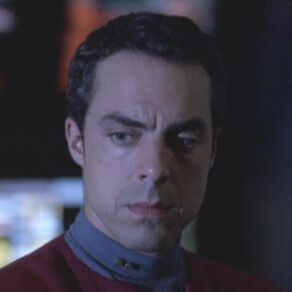
Or perhaps as "Starfleet officer murdering intelligent beings for spaceship fuel" in Star Trek: Voyager:
Maxwell Burke.jpg
"The Paramount folks found this expression too intense for Star Trek."

He's generally a character actor for shows (Sons of Anarchy, The Good Wife), which is sad, because Titus Welliver is actually a pretty decent actor, which I did not define by lowering the bar to "not having a brow-heavy glower in every scene."

While Harry Bosch does have his share of brow-heavy glowers (how could he not?), he's a troubled soul with a large arsenal of non-glower facial expressions. The season starts with Bosch shooting a suspected serial killer who turns out maybe to be unarmed, and he gets sued for it.

Bosch being in trouble for doing the right thing in sort of the wrong way is a recurring theme. His respect for police procedure and "the rules" is at his convenience, but he does get caught for it. Usually, though, he gets off with only a minor penalty because he did in fact stop a very bad guy, although it's not because the bad guy was bad, it's because punishing Bosch would be politically inconvenient for the LAPD. 

And then, for the first season's story arc, some other police find Evil Clone of Mark Ruffalo (Jason Gedrick, previously on Dexter) with a murdered male prostitute in the back of his panel van.
"I swear I have no idea how that rent boy got into my panel van to then stun gun and strangle himself to death."

Dark Ruffalo is named Raynard Waits, and after a day of pretending he knows nothing about anything, he then claims to have murdered a bunch of folks, including a a long-dead child whose remains Bosch has just found. But Bosch is pretty sure Dark Ruffalo didn't commit that murder. 

Finding out who did, and whether Dark Ruffalo will get his due, provides the tension for the season. And it is tense. Promising leads go nowhere, Bosch makes ill-considered decisions in his personal and professional life, and the higher-ups in the LAPD (mostly The Wire's Lance Reddick, playing a different high-ranking policeman) and District Attorney's office are scheming to take maximum political advantage of the fallout. 

Did I mention the opening theme? It's Caught a Ghost's "Can't Let Go," which is the best expression of jazzy jadedness towards life since Morphine's "The Night." It predisposes you to a story of grit, of perseverance against near-certain failure, of an ugly world that still needs saving. It's a great theme. 

So, if you have Amazon Prime, spend some time watching Bosch. Unless you hate gritty detective stories, you won't regret it.